How to Spot a Fake Dating Profile: 12 Signs and a Quick Check
How to spot a fake dating profile on Tinder, Hinge, Bumble or Facebook: how scammers build one, 12 signs that give it away and a simple 5-minute check.
The Romance Check · November 24, 2026 · 10 min read
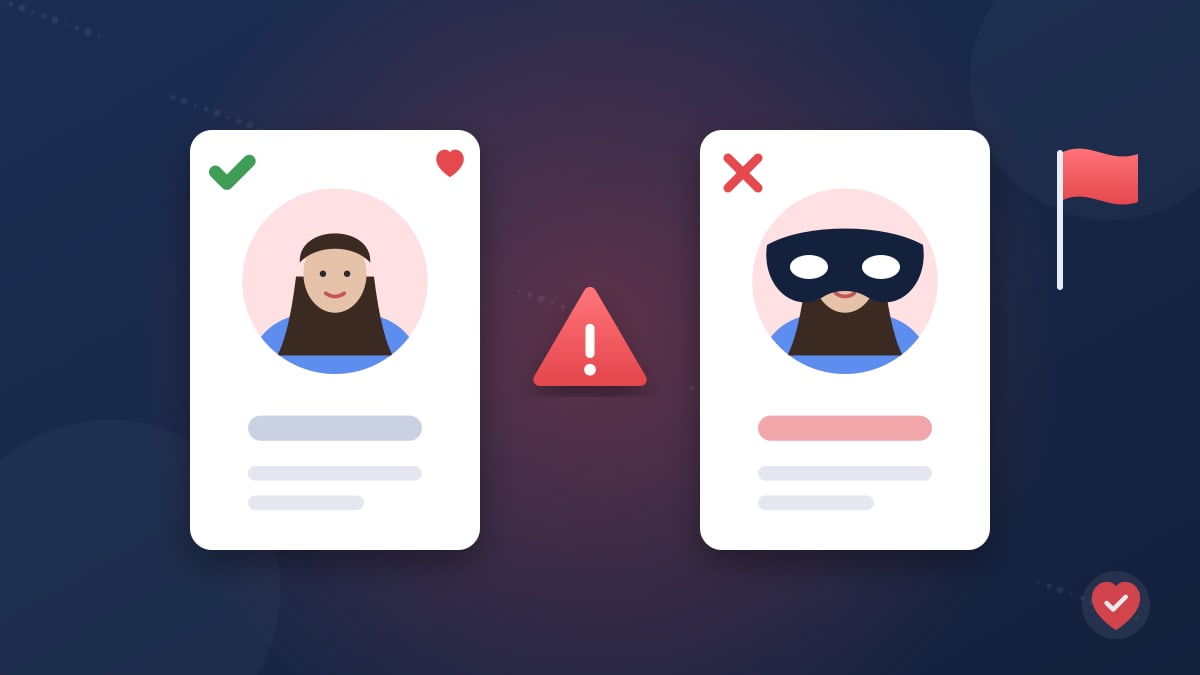
Short answer: To spot a fake dating profile, look for cracks between the photos, the bio and the behavior. Reverse-search the pictures, check whether the job, age and location agree, and ask for a spontaneous video call. One odd detail proves nothing. Three or more mean you should stop and verify before sharing anything.
A fake profile is an assembled product. Somebody chose the face, the job, the sad backstory and the reason you can't meet.
This article is about the profile itself, before long conversations begin. It covers how fakes are built, 12 signs to look for, what to check on each platform, and a five-minute routine you can repeat for every new match.
How a fake dating profile is put together
The same ingredients appear again and again:
- A face. Often a whole set of photos taken from one real person's public account, or a face generated by AI.
- A respectable job with absence built in. The US Federal Trade Commission (FTC) lists typical excuses for not meeting: living or traveling abroad, working on an oil rig, serving in the military, working for an international organization. In its 2022 data, a faraway military base was the most popular excuse, and offshore oil rig worker was another common fake job.
- A sympathetic family story. Widowed, or raising a child alone. Plenty of honest people are, which is why it works.
- A short, general bio. Loyal, honest, loves travel, looking for something serious. Nothing that can be checked.
- A location that almost fits. Close enough to match with you, with a reason to be somewhere else.
- An exit. A phone number or a username for another messenger, where the app's moderators can't see what happens.
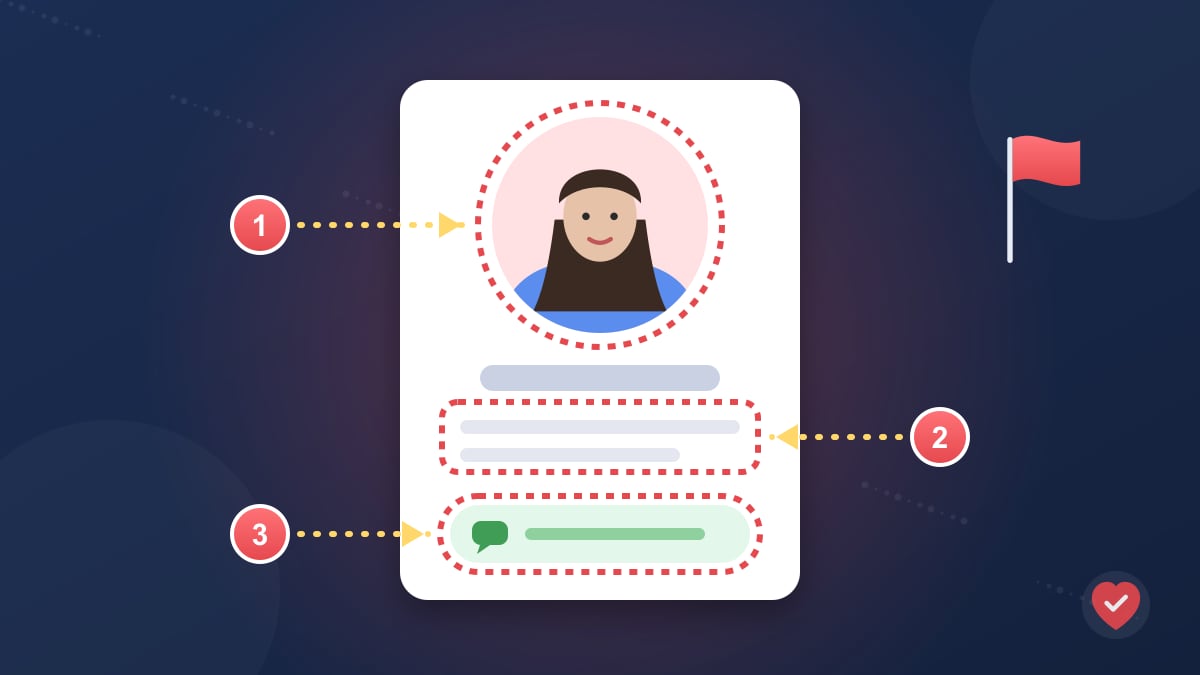
Three places where a fake tends to crack: 1, the photo; 2, the bio; 3, the link that takes you elsewhere.
Dating apps are only part of the picture. The FTC reported in April 2026 that nearly 60% of people who lost money to a romance scam in 2025, and said how it began, pointed to a social media platform. Reported losses from those cases reached $298 million. Scammers often tailored their act to people's profiles, so a stranger who happens to share all your interests may simply have read your page.
12 signs of a fake profile on a dating site
Count them, but don't panic over any single one.
Photos
- One to three pictures only, with no variety.
- Everything is polished, tightly cropped or watermarked, as if lifted from a portfolio or another site.
- The timeline doesn't add up. Age, hairstyle or season shifts strangely between photos described as recent.
- No ordinary life. No friends, no messy kitchen, no bad selfie, no group shots.
- Traces of AI. Mismatched earrings, odd hands, nonsense lettering in the background, identical lighting in every shot.
Bio and facts
- Generic or copied lines. Paste a distinctive sentence into a search engine, in quotation marks.
- An unusual job that explains away every meeting. We took one such persona apart in our piece on the offshore engineer fake profile. You can also search the job together with the word "scammer", as the FTC suggests.
- Contradictions. The age, height, city or native language in the profile doesn't match what the person writes.
Account behavior
- A new account with few friends or almost no history.
- An instant push to WhatsApp or Telegram, sometimes in the first few messages.
- Replies at odd hours for the time zone they claim.
- No real video call. It is refused, postponed, or turns into a few silent, blurry seconds.
A fair reading: the sign, the innocent reason, the check
Real people write bad bios, work abroad and hate video calls. This table keeps you fair as well as safe.
| Sign | Innocent explanation | What to check |
|---|---|---|
| Very few photos | Private or new to the app | Ask for a casual photo from today; reverse-search the rest |
| Polished studio pictures | Works in media, or paid for a photographer | Look for the same pictures under another name |
| AI-looking details | Heavy filter or beauty mode | Compare several photos, then ask for a live call |
| Job at sea or abroad | Many people do work there | Ask simple questions about the routine and compare the answers later |
| Wants another messenger | Dislikes app notifications | Suggest staying in the app for now and note the reaction |
| New account | Just signed up or came back | Look for older traces elsewhere under the same name |
| Avoids video | Shy, or poor connection | Offer a two-minute call at a time that suits them |
As a rule of thumb, one sign is a question. Three or more signs mean you pause, verify, and share nothing further until you have answers.
How to spot a fake dating profile: a 5-minute check
- Minute one: read everything once. Note the age, job, city, languages and family details. Do they agree with each other?
- Minute two: reverse-search the main photo, and one less formal picture. Another name, or details that don't match, are signs of a scam according to the FTC. Our tutorial shows how to reverse image search a dating profile on a phone or computer.
- Minute three: search the words. Try the first name with the job and city, the username, and one sentence from the bio.
- Minute four: check the contact details. Our free profile check can reverse-search photos and flags virtual phone numbers and disposable emails.
- Minute five: ask for something spontaneous. A short video call now, or an everyday question about where they are.
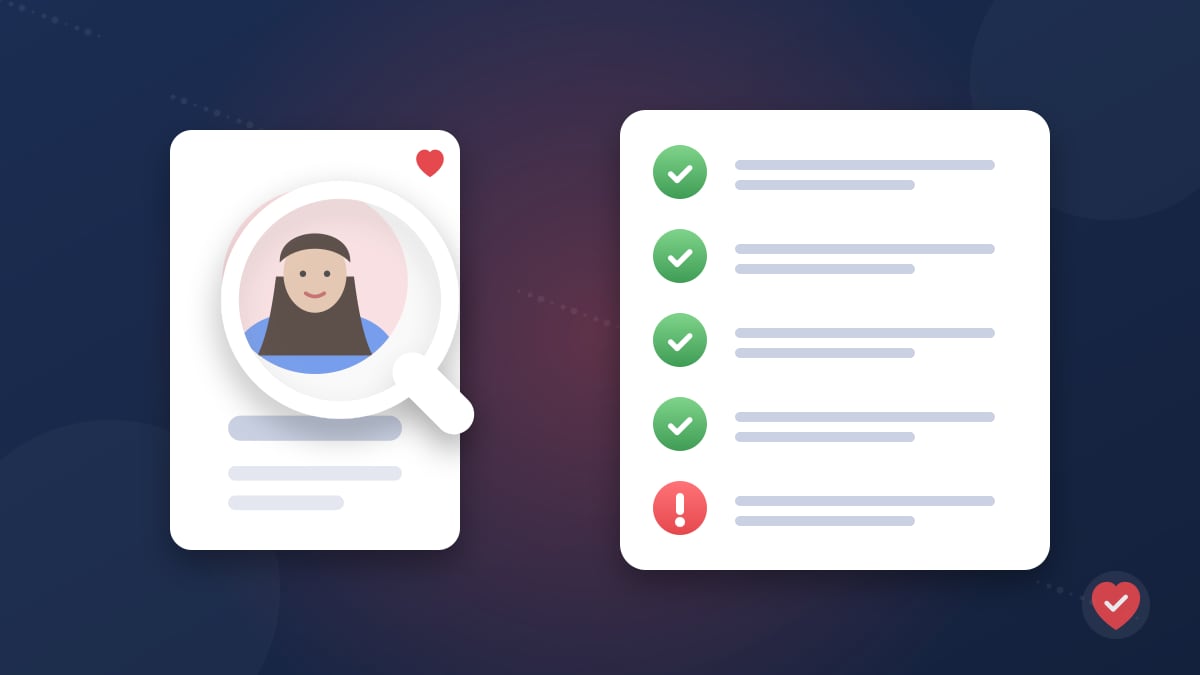
Five minutes before the conversation gets personal is easier than five weeks of doubt.
A clean reverse search doesn't prove that the person is real. New, private or AI-generated images may simply not appear anywhere.
Fake profiles on Tinder, Hinge, Bumble and Facebook
Tinder
Look at the photos as a set, at the distance shown, and at any linked Instagram. Does the account have older posts and comments from real people, or a dozen pictures added at once? Tinder's "Photo Verified" badge appears when a person passes a liveness check and the profile contains a clear solo face photo matching the video selfie. Tinder itself says the badge can be a signal but not a guarantee of identity, information or safety.
Hinge and Bumble
Prompts and written answers give you more to work with than a photo alone. Are the answers specific, or could anyone have written them? Do the photos support the story? These apps have their own badges, and their help pages explain what each one means. No badge on any app proves intentions: a verified person can still lie about money, work or marriage.
Facebook and Facebook Dating
If you can see the person's Facebook page, look for a life that other people took part in:
- a friends list with people who interact with them;
- tagged photos posted by others;
- comments that sound like real conversations;
- posts spread over the years, instead of a bulk of photos added on one date;
- a profile name that has nothing to do with the web address of the page.
On Facebook Dating you may see less, so a spontaneous call matters more. The FTC also advises limiting who can see your own posts and contacts. The less a stranger can learn about you, the harder it is to pose as your perfect match.
How to tell if someone is catfishing you
Ask questions that a real person answers without effort.
- "What can you see from your window right now?"
- "What was the best thing you ate this week?"
- "Which part of town do you usually go out in?"
- "Could we do two minutes on video? I'm free now."
Honest people may decline a call once and suggest another time. Catfish tend to give you a reason, then another reason, then a guilt trip.
Video isn't the final proof it used to be. AI can fake a live face, and a call can be staged with a recording. Ask the person to turn their head, move a hand in front of the face or change the light, and compare the call with everything else. Before an actual date, go through the checklist for verifying an online date.
When the photos belong to a real person
A reverse search may lead you to somebody with a different name who has no idea that their pictures are being used.
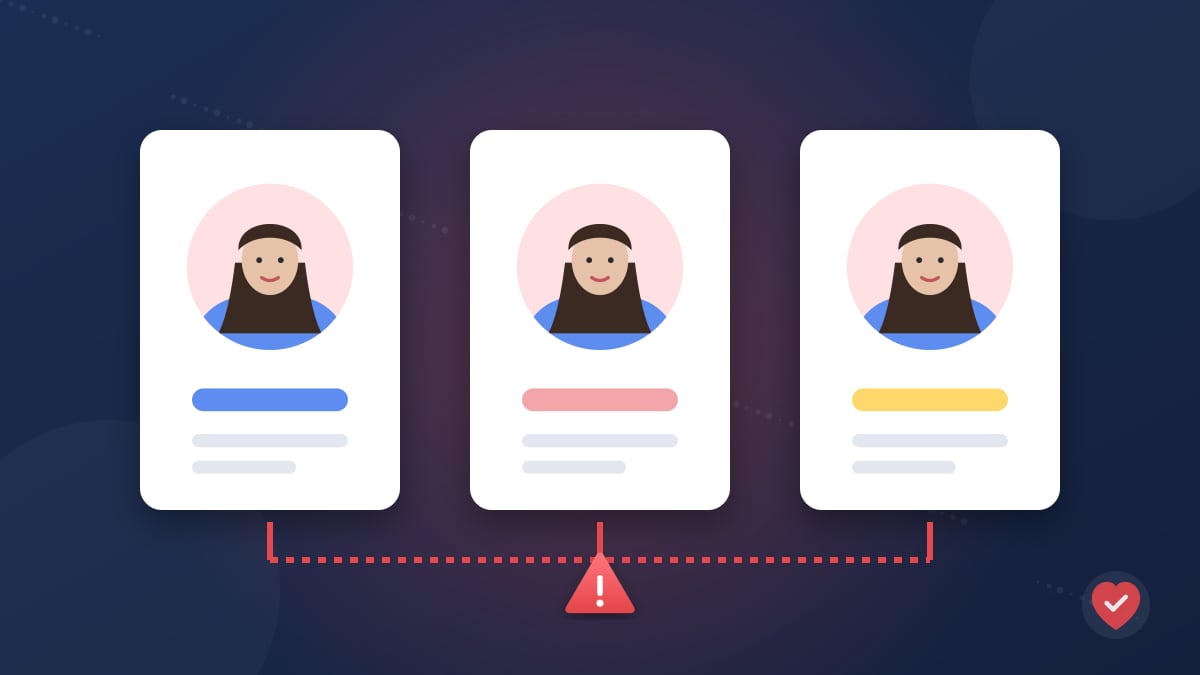
One face, several names. The person in the picture is usually a victim as well.
Don't accuse them, send angry messages or publish their photos in a "scammer" post. If you contact them at all, keep it short and polite: "Your photos are being used on this profile, here is the link."
What to do if you find a fake profile
- Don't confront the account. It teaches the scammer what gave them away and invites a convincing excuse.
- Take screenshots of the profile, its link, the photos, phone numbers and messages.
- Report it in the app, then block it. In the US, also report it at ReportFraud.ftc.gov.
- Never send money to someone you haven't met, whatever the reason. Medical bills, tickets, visas and crypto are familiar requests, and instructions on how to pay, such as wire, gift card, payment app or crypto, are part of the script.
- If you already shared money or bank details, act now. Our guide explains how to get money back after a romance scam, step by step.
- Warn others by sending the details to our scammer report form.
If you believed the profile for a while, that says nothing bad about you. It was built to be believed. Talk it over with someone you trust; a second pair of eyes often sees the crack at once.
FAQ
How can you tell if a dating profile is fake?
Compare the photos, facts and behavior. Reverse-search the pictures, look for contradictions in job, age and location, and ask for a spontaneous video call. Three or more warning signs are a reason to stop and verify.
Can a verified Tinder profile be fake?
The badge shows that a person passed a liveness check and that a clear solo face photo matches the video selfie. Tinder says it can be a signal but not a guarantee of identity, information or safety. Someone real can still lie about their life and intentions.
What should I do if someone is catfishing me?
Don't confront them. Save screenshots, report the profile in the app and block it. If you sent money or shared financial details, contact your bank immediately.
Source: FTC
Not sure about someone? Check their profile in seconds.
Check a profile