Romance Scammer Failed to Report to Prison, Indictment Says
A convicted romance scammer allegedly skipped her prison date. See what is proven, how the fake general scheme worked and why company accounts fool people.
The Romance Check · November 23, 2026 · 8 min read

Short answer: A 46-year-old Atlanta woman who pleaded guilty in a romance scam was sentenced to eight years in January 2026. Prosecutors say the convicted romance scammer failed to report to prison by March 25. A new indictment charges her over that. The fraud conviction is established; the new charge is still an allegation.
The case comes from New Orleans, where the U.S. Attorney's Office for the Eastern District of Louisiana announced the new charge on October 28, 2026. For anyone who dates online, the older part of the file is the useful one: court records describe, step by step, how the money was taken.
What is proven, and what is only alleged
The fraud case is closed for her on the question of guilt. She pleaded guilty to conspiring to defraud mostly older women in a romance scam, and she admitted responsibility for $851,207 in victim losses. Her codefendant, a man from Marietta, Georgia, took his case to trial. After four days, a jury convicted him in July 2025. He was found responsible for losses exceeding $3.5 million, was sentenced to 25 years and is in custody serving that term.
The failure-to-report case has only begun. A federal grand jury indicted her on that charge on October 23, 2026. The prosecutor's office stresses that an indictment is merely an allegation, and that guilt must be proven beyond a reasonable doubt. On this charge she is presumed innocent.
How a romance scammer allegedly failed to report to prison
| Date | What happened | Status |
|---|---|---|
| April 2024 | Grand jury in New Orleans indicts her for conspiracy to commit mail and wire fraud and conspiracy to commit money laundering | Later followed by a guilty plea in the romance scam |
| July 2025 | Codefendant convicted after a four-day jury trial | Convicted, sentenced to 25 years |
| January 2026 | She is sentenced to 96 months and allowed to stay on bond | Court record |
| March 24, 2026 | Her GPS monitoring device stops operating; last known location is Atlanta's main airport | According to authorities |
| March 25, 2026 | Deadline to report to the Bureau of Prisons | Authorities say she did not report |
| October 23, 2026 | New indictment for failure to report | Allegation, not proven |
She had been arrested in Atlanta after the first indictment and released on bond. Authorities say she gave her probation officer details of a flight to Minnesota, where she was to serve the sentence. According to airline records, she did not board.
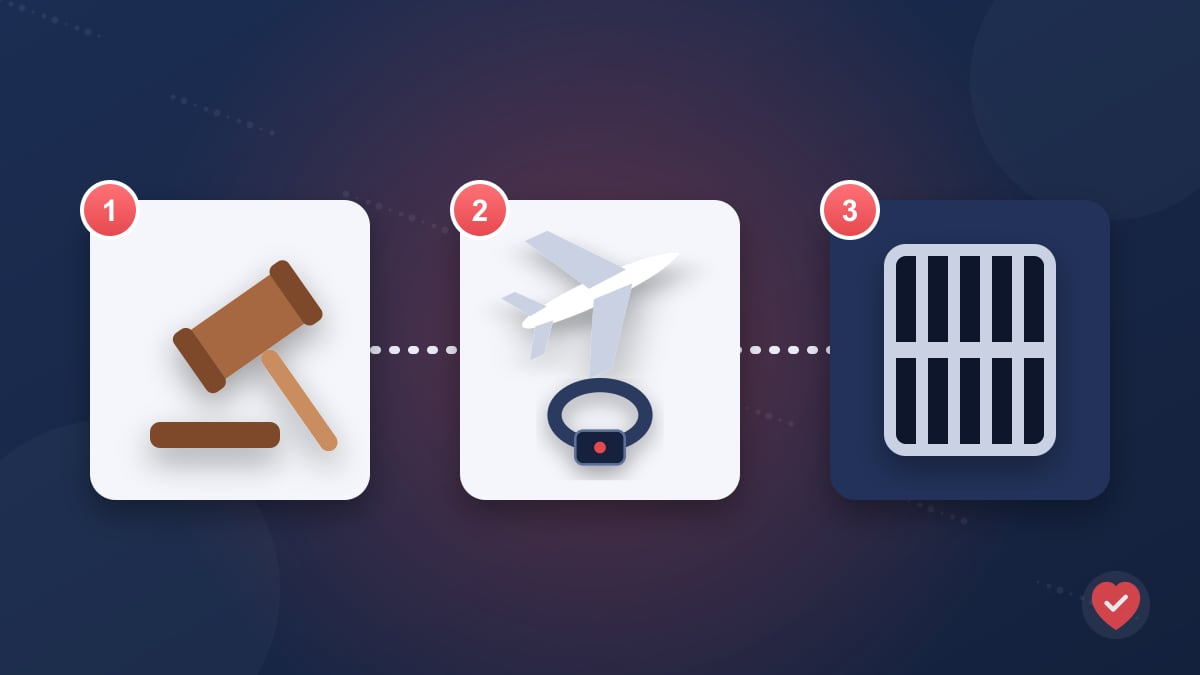
From the verdict to the airport to the empty door: the sequence described by authorities. The last step is the new, unproven charge.
As of October 28, 2026, she was at large, a warrant was out, and the FBI was offering a $5,000 reward for information leading to her arrest. That may have changed since. Anyone with information should pass it to the FBI.
If she is convicted of the new charge, she faces up to 10 years, to be served after the earlier sentence and not alongside it. The law also allows a fine of up to $250,000 and up to three years of supervised release.
Inside the scam: the fake general romance scam playbook
According to trial evidence and court documents, the method had a clear order. None of the steps looks alarming on its own, which is why careful, educated people can follow it to the end.
- An impressive stranger appears. Members of the conspiracy posed as generals, philanthropists or entrepreneurs living outside the United States. They met victims on Facebook, Instagram and similar platforms.
- Trust comes first. The scammers gained the victim's confidence.
- The chat moves. Victims were asked to switch to WhatsApp or another encrypted platform.
- It becomes a romance. The scammers built a romantic relationship before they asked for anything.
- A good cause needs help. The requests came with reasons such as charitable work or sick relatives.
The three characters have something in common. A general, a philanthropist and an entrepreneur all have status, a reason to be abroad and a reason to be hard to reach. Each also explains away a question that would otherwise come up: why can't we meet? We look at the uniform version in more detail in our article on the fake deployed soldier scam.
The requests work on a similar principle. Asking for charity money or help with a sick relative turns the payment into proof of kindness. Saying no feels like failing a person in need.
The company account: the detail worth remembering
Court documents say the two set up a company that was used in the scam. Victims' money was deposited into accounts in the company's name, then transferred to accounts elsewhere, including foreign banks.

The route in court documents: victim, company account, then other accounts, including foreign banks.
Many people have learned to be wary of sending money to a private stranger. A business name on the transfer form feels safer. But a company account does not make a payment legitimate. Registering a company and opening an account in its name does not prove that the story behind the payment is true.
So the name on the account is not the question to ask. Ask who told you to send the money, whether you have met that person, and why your sweetheart's crisis is being paid through a business.
How to check someone who claims this life
You don't need to confront anyone. Quiet checks come first:
- Search the photos. Pictures of officers and businesspeople are often taken from someone else's page. Here is how to reverse image search a dating profile.
- Run the profile through our free check. It can reverse-search photos and flags virtual phone numbers and disposable email addresses.
- Compare the messages with phrases romance scammers use.
- Verify the cause separately. Look up the charity or company through contact details you found yourself, not ones you were sent.
- Ask for a live video call, and treat repeated excuses as information.
- Tell one person you trust before any money moves, and go through the 10 red flags together.
If you have already sent money
Contact your bank immediately and say that you paid a romance scammer. Give them the recipient's name, the account and the date of each transfer, because a transfer that is still in progress is easier to stop than one that has moved on.
Keep the messages, receipts and usernames. In the US, report to the FBI's Internet Crime Complaint Center (ic3.gov) and the FTC (ReportFraud.ftc.gov); in the UK, report to Action Fraud. Report the profile to the platform too, and tell us your story so that other people can recognize it. Then stop paying, including any "fee" to get the earlier money back.
Why a prison term rarely brings the money back
Generally speaking, an arrest and a refund are two separate things. By the time a case reaches court, the money has often passed through several accounts, crossed borders or been spent. Even when a court orders repayment, collecting it depends on what can still be found.
Reporting still matters. One complaint may look like a private misfortune, while several complaints that name the same account begin to look like a scheme. A quick report also gives the bank its best chance to act. And it helps with the shame: the people behind this scam were organized, and being deceived by them is not a failure of intelligence.
FAQ
What sentence did the romance scammer receive?
She was sentenced to 96 months, or eight years, in January 2026 after pleading guilty in the romance scam. Her codefendant was convicted by a jury in July 2025 and sentenced to 25 years. The new charge could add up to 10 years, but only if she is convicted.
Has she been found guilty of failing to report to prison?
No. A grand jury indicted her on October 23, 2026, and an indictment is an allegation that must be proven beyond a reasonable doubt. Her fraud conviction is a separate matter and rests on her guilty plea.
Is it safe to send money to a company account for someone I met online?
Not for that reason alone. In this case, court documents say victims' money went into accounts in a company's name and was then moved on, including to foreign banks. If you have never met the person asking, don't pay, whoever owns the account.
Source: U.S. Attorney's Office, Eastern District of Louisiana
Not sure about someone? Check their profile in seconds.
Check a profile